
substack audience and their love for sad stories
why my most-liked piece made me feel nothing


How do you make your essay go viral? Hooks? Quality content? Something that teaches people something? Nope. All you need is a sad, sad story. Write about the hardships you went through, how your family argued day and night, how your dad was a horrible father figure, how money always seemed like a distant dream, and how self-harm was your night routine. Like a moth to a flame, people will come, stay, and read. Which, essentially, isn’t a bad thing. My question is, how much grief will you write about until there’s no more grief to write about?
the mythology of the sad writer
There is a common misconception (now, I’m not too sure) that writers—at their core—are sad people. I mean, Sylvia Plath put her head in the oven, Kafka spent his life in quiet agony, Osamu Dazai wrote himself into death—we know all about that one now, do we not? One of the most common ways writers begin their first pieces is after a tragic, life-altering event, to cope with grief. Which isn’t bad at all. It’s a healthy coping mechanism—to express your feelings, your grief, to be strong while being vulnerable.
grief as performance
I think somewhere along the path of expressing hurt in the form of writing online, it changed from an art form to a rat race of “who is the saddest of them all?”. People tend to read it more, the algorithm promotes it more, rewards it. Because readers linger longer on pain than they do on peace. Because sadness feels profound, while happiness feels… almost embarrassing to articulate. No one wants to read about a good day. No one wants to sit through contentment. What is one to do, if their grief is the only thing that gets them rewarded—make them feel happiness? It becomes a vicious cycle—of finding hurt in things that aren’t even supposed to hurt. No seriously, what do you mean you’re getting sad looking at economically less privileged people working and earning an honest living? That’s pity. Don’t do that.
this is not an attack
It’s okay to write about your grief. I wouldn’t dare shame you for it—I write it too. You’ve probably read it too. Stayed a little longer than you intended to. Felt something sit heavy in your chest and thought, this is good writing. And it probably is. My question is, is the writing good because you find it relatable, or is it relatable because you find the writing good? Would you still read an essay if it didn’t make you feel something on a personal level? Most people would say no. Understandably so. Some things don’t leave you alone unless you put them somewhere, and writing just happens to be the easiest place to put them.
what we choose to read
My criticism isn’t of the writers. It’s of the pattern.
Over the past two weeks, I’ve gone through countless poetry and prose on Substack to look for patterns to verify this pattern. I came across so many good pieces with little to no likes or interaction. One common pattern among these pieces was that they weren’t about grief or personal struggles. They focused on different topics and dimensions. I too wrote about my childhood and self-harm. What was meant to be an artistic getaway of old memories turned out to be my most liked piece till now. And while I should have felt good about getting recognition for that article, I couldn’t find a single happy bone in my body. Instead, I just stared at my screen, looking at the huge number of strangers interacting with my grief. I didn’t know what to feel. Is it better to speak or to die? I asked myself that question when I was posting that article. I’m not so sure anymore.
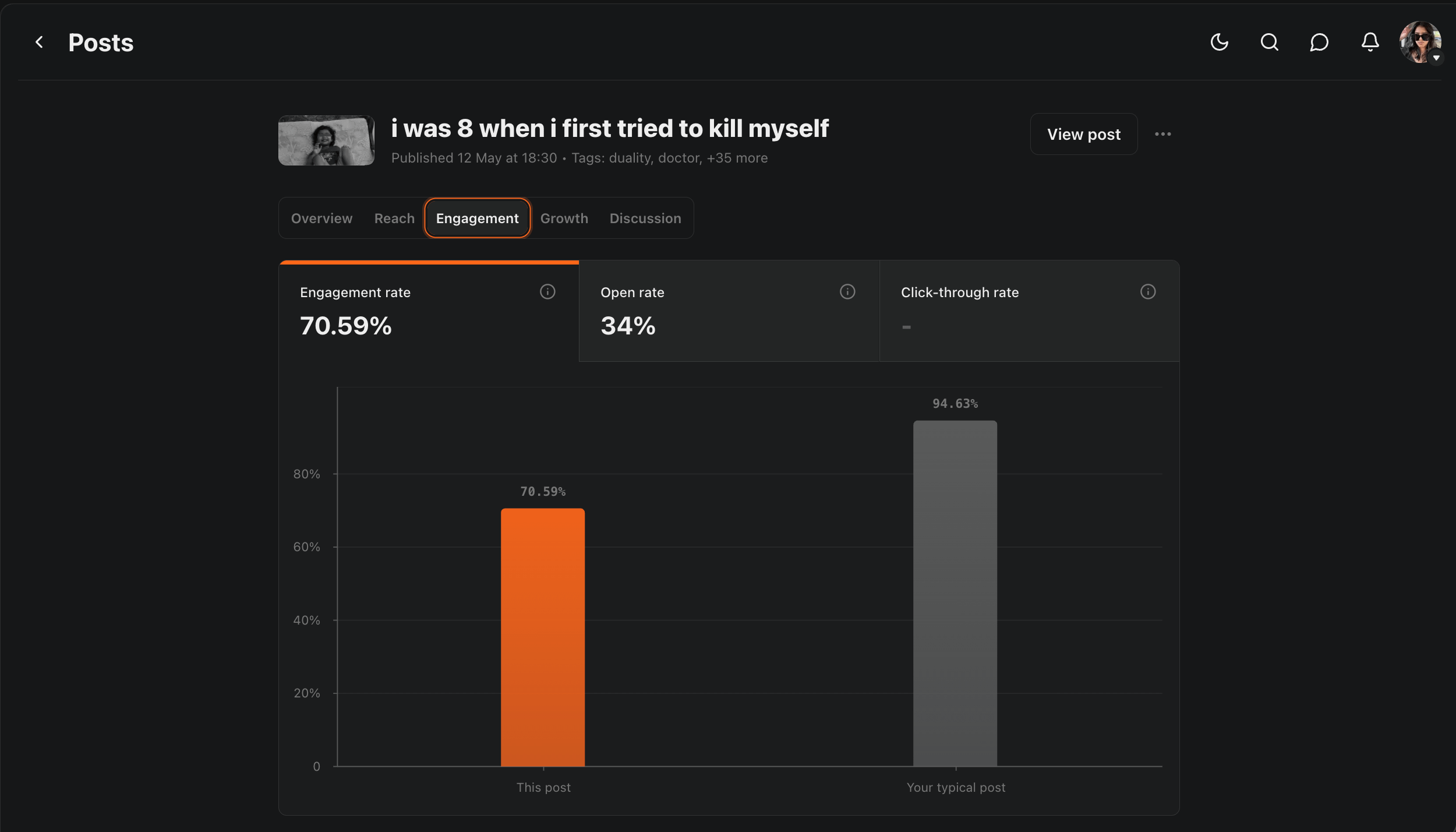
the need to relate
I wouldn’t shame you for reading sad pieces either. Humans have a tendency to search for connections. We look for ourselves everywhere. The articles—they’re relatable. In other people’s words, in sentences that feel a little too familiar, a little too precise. Grief has a weird way of connecting people together. More than happiness ever could, unfortunately. I mean, there must be a reason why the concept of ‘trauma bond’ exists, but not ‘happiness bonds.’ I think that maybe that’s all anyone really wants—to feel seen, even if it’s through something that hurts.
when grief becomes currency
When we talk about writing about grief, we need to think about what happens after you’re done with the grief and have moved on. What happens when you start measuring your worth as a writer by how much you’ve suffered? What happens when healing feels like losing material? What happens when moving on makes your writing… less interesting? Because then grief becomes currency. You spend it carefully at first. A paragraph here, a memory there. But the more people read, the more they praise, the more they stay—you start digging deeper. Even if it means bleeding a little more than you needed to.
so, how much is enough?
My question is still the same. How much grief will you write about until there’s no more grief to write about? And when you finally run out—will you still have something to say, or will no one be there to listen?
The answer is simple. You don’t run out of grief. You run out of new grief.
The same childhood, the same father, the same self-harm—after the fifth essay, the tenth, it stops being excavation and starts being rehearsal. And the readers can tell. They don’t leave because you’ve healed. They leave because you’ve started performing a memory instead of living inside it.
So no, you won’t run out of grief. But one day, if you’re lucky, you’ll have more interesting things to say than “look how much I hurt.” And the people who stay for that—those are your real audience. Not the moths. The ones who’d read you even on a good day.
And I hope that one day, you get to write about all the happy days in your life, and your readers still stay for the rainbow after the rain.
like yes you said it loud and im speechless because i have seen it so many times, in so many different ways. ofc i write sad too, sad poetry, sad prose. sometimes. and i have a lot of empathy towards people who write sad, and a lot of respect too cuz vulnerability is courageous. but always used to wonder how much sad is too much sad? well, maybe your essay is the answer.
Wow